
Procedural, parametric and generative design are related—not interchangeable
Parametric design exposes meaningful variables, procedural design applies encoded rules, and generative design searches or proposes alternatives toward a goal. A tool can combine these methods, but calling every automated result “AI-generated” hides how the result can be controlled and reproduced.
Last updated: 25 August 2026 · Definitions applied to the current Metropolygonia workflow
Three methods in plain language
| Method | What drives the result | Typical strength | Main review question |
|---|---|---|---|
| Parametric design | Named values and relationships, such as width, storeys or roof height | Direct, explainable editing | Do the parameter ranges express the intended design space? |
| Procedural design | Rules and ordered operations that construct the output | Consistent systems and scalable variation | Do the rules handle normal and edge cases? |
| Generative design | A search, optimisation or model proposes candidates from goals, examples or prompts | Exploration of a broad possibility space | How are candidates evaluated, constrained and verified? |
A workflow can be both procedural and parametric
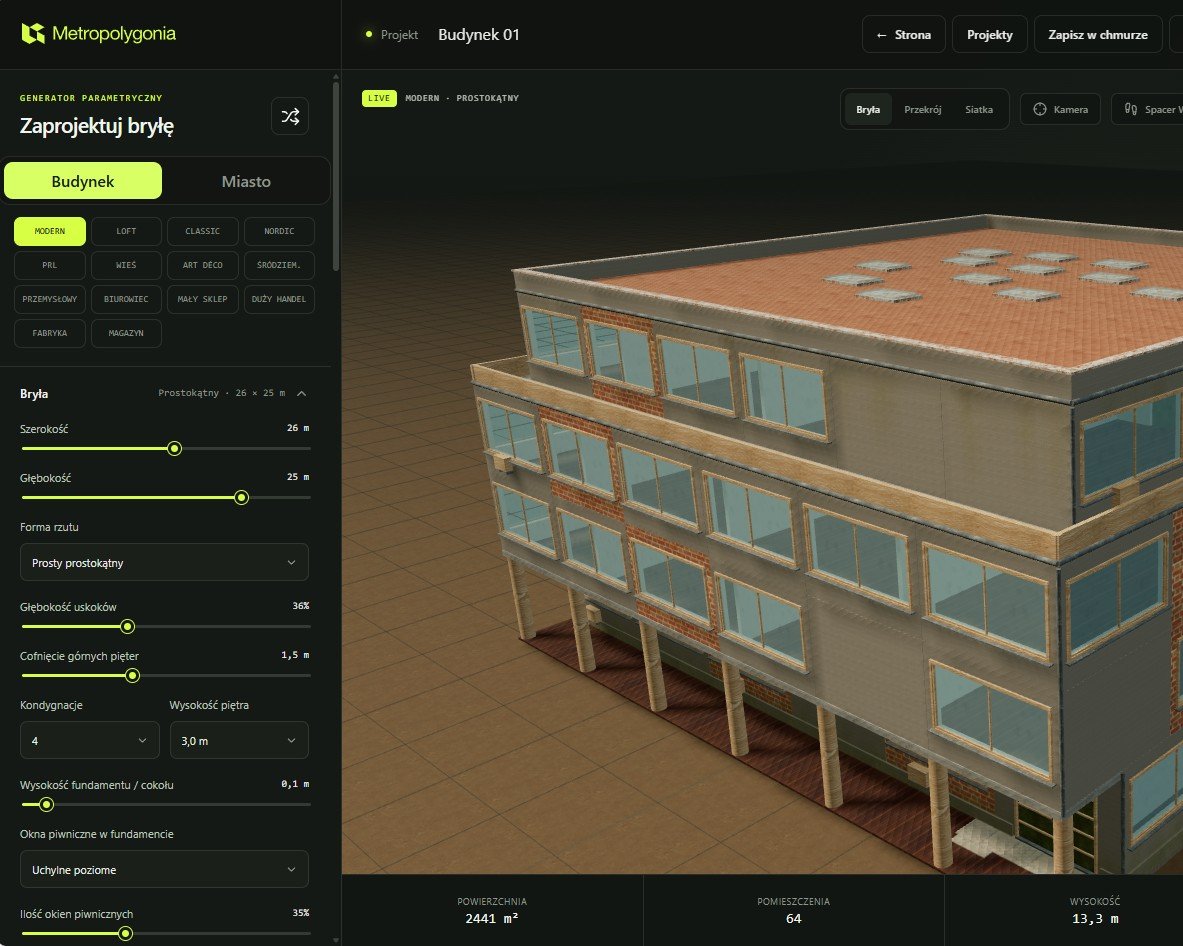
These labels describe different aspects of a system. A building generator can expose parameters for dimensions and facade choices while procedural rules turn those values into walls, openings, roofs and details. Relationships between parameters may constrain valid combinations, and a seed may select repeatable choices inside approved ranges.
Metropolygonia fits this combined procedural-parametric model. Geometry is produced in the browser from explicit controls, rules and repeatable seeds. It is not created by entering a text prompt into a text-to-3D generative-AI model.
When inputs and rules are known, a team can reproduce a result, compare variants and diagnose an unwanted change. That is different from merely receiving a plausible output whose construction logic is hidden.
Choose the method from the kind of uncertainty
- Known form, changing dimensions.Use parametric controls when the design logic is established and users need precise, meaningful adjustments.
- Known system, many instances.Use procedural rules when repeated construction, coherent variation or regeneration would save manual work.
- Unknown solution, measurable goal.Use generative search when many candidate solutions should be explored and there is a credible way to evaluate them.
- Open-ended visual ideation.AI-generated references may help exploration, but they still need authorship, rights review, feasibility checks and translation into controlled production data.
How one architectural variant is produced
A designer first chooses explicit values such as footprint, height, construction type and roof family. Procedural rules then derive the required surfaces and repeat facade elements across the available bays. A seed can make permitted choices repeatable. The resulting mesh is inspected, saved as project JSON and exported only after it satisfies the brief.
This sequence keeps authorship visible: a person defines the design space and approves the result; parameters describe the instance; rules construct it; the seed reproduces selected variation. The seed and variant guide explains how to record that state.
Judge outputs by evidence, not labels
- Control: Can a user intentionally change the dimensions or architectural system?
- Repeatability: Can the same inputs recreate the same useful result?
- Traceability: Can a reviewer identify the source settings and version?
- Constraints: Are invalid or undesirable combinations bounded?
- Verification: Is geometry checked for the destination instead of assumed correct?
- Ownership: Are authored inputs, generated outputs and third-party assets handled under the relevant licences?
Design-method FAQ
Is all procedural design generative design?
No. A procedure can construct one predictable result from explicit inputs without searching a solution space or using an AI model.
Is a parametric model automatically procedural?
Not necessarily, but many practical systems are both: parameters expose controls while procedures rebuild dependent geometry.
Does a random seed make a tool generative AI?
No. A seed is a deterministic input to a pseudo-random process. It can select among encoded options without machine learning or prompt-based generation.
Which approach is best for game buildings?
For coherent families with measurable dimensions, a procedural-parametric source is often a strong base. The game-building workflow shows where manual art and engine work still belong.