
Procedural buildings for games: a practical asset workflow
Procedural buildings are most useful in games when a team needs many coherent variations, reproducible source settings and faster blockout-to-asset iteration. They complement art direction; they do not replace engine-specific collision, LOD, lighting or performance work.
Last updated: 25 August 2026 · Verified against the current Metropolygonia generator
- Rule-drivenGeometry follows explicit controls
- MetricDimensions are stored in metres
- RepeatableSeeds and project JSON preserve intent
- PortableGLB, glTF, OBJ and STL outputs
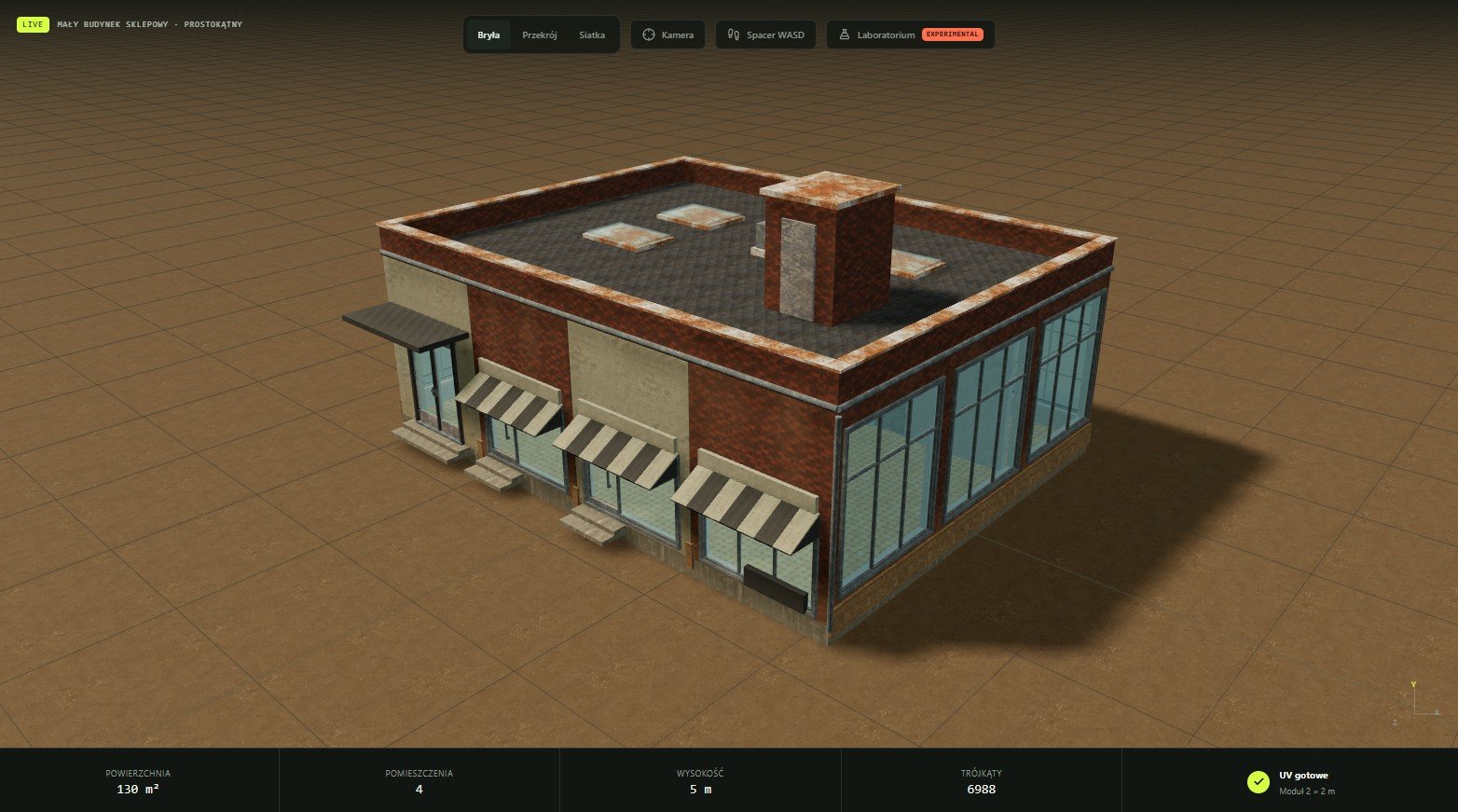
When procedural buildings earn their place
Use procedural generation where variation is systematic: background streets, repeated urban blocks, rapid level-design tests, architectural families or alternative art-direction passes. A parameter set can express width, depth, storeys, facade rhythm, roof and selected details without remodelling every combination.
| Production need | Procedural contribution | Work that remains manual |
|---|---|---|
| Fast blockout | Metric envelopes and repeatable variants | Gameplay routes, sightlines and encounter design |
| Background variety | Related silhouettes, facades and roofs from controlled ranges | Hero dressing, storytelling and final composition |
| Pipeline consistency | Named parts, stable presets and a shared UV convention | Engine naming rules, import automation and optimisation |
| Iteration | Regenerate from parameters instead of editing a frozen mesh | Review, approval and downstream reimport policy |
Move from brief to engine in six controlled steps
- Define the role.Write down the footprint range, storey range, camera distance, accessible areas and whether the building is a hero, midground or background asset.
- Create one representative building.Set real dimensions first, then facade, roof, openings and optional interior scope. Follow the first-building guide if this is a new workflow.
- Save the procedural source.Keep the building project JSON and record the seed. The exported mesh is a snapshot, not the editable source of truth.
- Generate a deliberate variant set.Change one design family at a time and reject combinations that weaken the visual language or gameplay footprint.
- Export one test asset.Start with GLB for a modern game-engine handoff; use the format comparison when another target requires different data.
- Validate before scaling up.Check a known dimension, pivots, normals, material slots, UV scale and hierarchy. Only then batch the remaining variants.
Generated geometry is not a finished runtime asset
Metropolygonia can hand off metric meshes, named generated parts, material assignments and UV coordinates. GLB and glTF can embed supported image textures; OBJ carries MTL and PNG sidecars; STL is geometry only. This is useful production input, but the destination project still decides how an asset should behave at runtime.
Collision, LODs, Nanite decisions, lightmaps, navmeshes, occlusion, draw-call budgets, streaming rules and platform performance are not created automatically. In Unreal Engine, use the verified import checklist before scene-wide placement.
Review a variant set as a system
- Verify that entrances and traversable areas support the intended gameplay.
- Compare silhouettes from the actual gameplay camera, not only in the generator.
- Keep material density consistent with the 2 × 2 m base UV convention.
- Measure triangle, mesh and material-slot costs in the destination engine.
- Store the accepted preset, seed, export format and engine import settings together.
- Test representative extremes, not only the safest middle-sized building.
Procedural building FAQ
Are procedural buildings only for background scenery?
No. They are strongest where rules can carry much of the form, but a hero asset usually needs more authored storytelling, bespoke geometry and a stricter optimisation pass.
Does the generator use text-to-3D AI?
No. Metropolygonia creates geometry from explicit rules, parameters and repeatable seeds. The distinction is explained in the procedural, parametric and generative design guide.
What should be version controlled?
Keep project JSON, seed, approved screenshots or review notes, export settings and downstream import settings. Large generated meshes can then be rebuilt or replaced under the team's asset policy.
Can one export become an entire game-ready city?
The city package can separate buildings and chunk terrain, roads and infrastructure, but the game project still owns streaming, collisions, navigation, lighting and performance.